How Many Calories Should You Eat in a Day?
How many calories you should eat per day: the Mifflin-St Jeor math, activity reality, and the three numbers (BMR, TDEE, deficit) that decide everything.
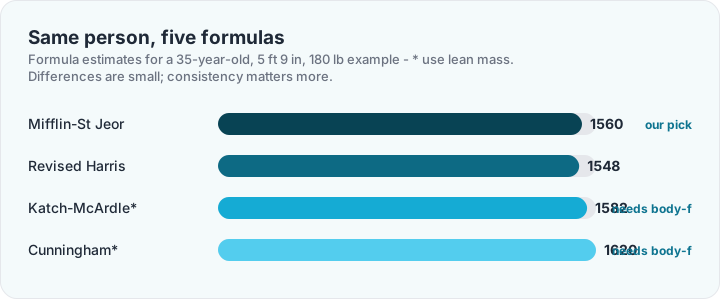
"How many calories should I eat?" is the most-asked question in nutrition, and the honest answer is a small procedure rather than a number. Your body burns calories in four pots: BMR (60-70% — keeping you alive), activity (exercise and movement), TEF (digesting food, ~10%), and NEAT (fidgeting, walking, the uncounted rest). Maintenance is the sum: eat that, weigh the same.
The formula route: BMR via Mifflin-St Jeor (our TDEE calculator does it), multiplied by an honest activity factor. For a 35-year-old woman, 5'6", 160 lb, lightly active, that lands near 1,900-2,000; for a 40-year-old man, 6'0", 200 lb, moderately active, near 2,700. Public health round-numbers — 2,000/2,500 — are label conventions, not personal answers.
Then the three refinements that matter. Goal: a deficit of 300-500 kcal for loss, a surplus of 200-300 for gain (our deficit calculator automates this). Protein floor: roughly 0.7 g per pound of goal weight protects muscle while dieting. Reality check: whatever the formula says, your actual maintenance is discoverable only by eating at it and watching the scale's two-week trend — formulas start the estimate, your body finalizes it.
One number we will not give: a single "right" intake for your sex or age bracket. The spread within any group is enormous. The formula plus feedback is faster, safer and more accurate than any table — which is why this site is calculators and comparisons, not a chart.
Frequently asked questions
How many calories should a woman eat per day?
It depends on size and activity — commonly 1,600-2,400. Compute yours: BMR × activity in the TDEE calculator, then adjust for your goal. Round numbers on food labels are not personal answers.
Is 1,200 calories enough?
For small, sedentary people it can approach maintenance; for most adults it is an aggressive deficit that should be professional-supervised and time-boxed. The deficit calculator flags below-floor targets.
How many calories to lose 2 pounds a week?
Roughly 1,000 kcal below maintenance daily — an aggressive pace that suits fewer people than try it. A 500 kcal deficit at half the pace has far better adherence odds for most.
Do calories from junk food count the same?
For weight direction, largely yes — the energy balance does not grade food quality. For satiety, health and adherence, absolutely not: 400 kcal of chicken and rice keeps you full in a way 400 kcal of soda does not. Track the calories; choose the foods for the rest.
Should I recalculate as I age?
Yes — BMR drifts down roughly 1-2% per decade after 30 through muscle loss, and activity changes matter more. Recompute at every birthday decade and every 10-pound weight change; the calculator takes ten seconds.